
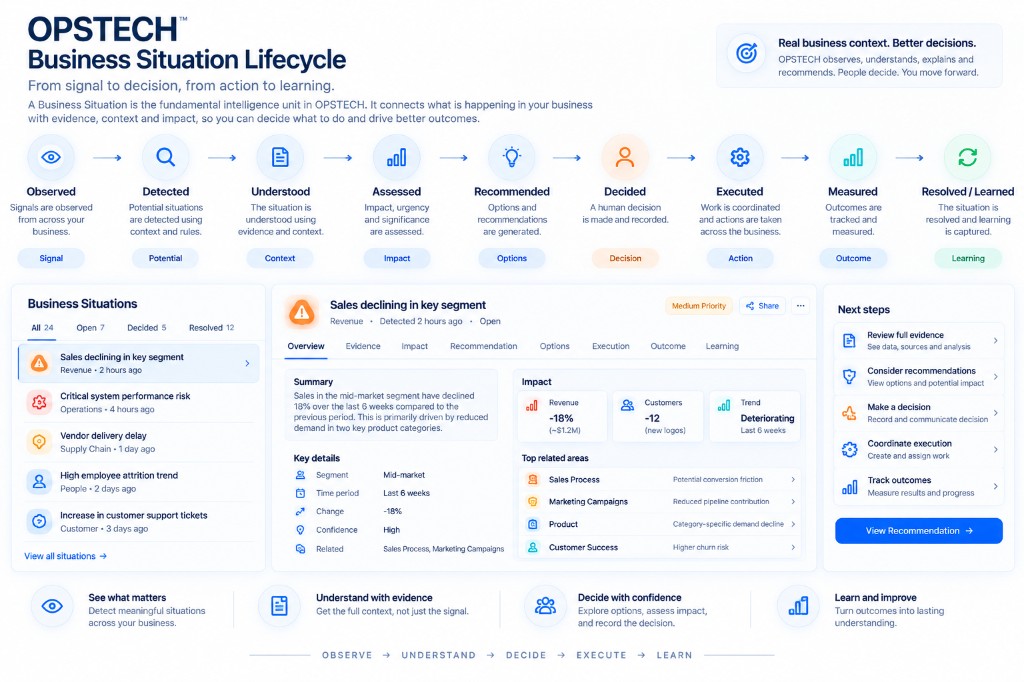
Business Situations

The unit of intelligence.

A Business Situation is something happening, emerging or potentially important that needs to be understood in business context — not a notification, not a ticket and not a generic AI alert.

OPSTECH Business Situation lifecycle from observation and detection through understanding, assessment, recommendation, decision, execution, measurement, and learning.

Why it is the unit of intelligence

The fundamental intelligence unit is the Business Situation. OPSTECH prioritizes business significance rather than raw event volume, and surfaces the small number of situations that materially deserve consideration.

Business Situation

Delivery risk may be increasing.

Evidence
Milestone slippage on Phoenix. Two dependent vendor dates moved. Implementation capacity is already committed.
Impact
Customer go-live may move by a quarter if the dependency is not resolved.
Cause
The work depends on a vendor capability supporting another high-priority initiative.
Confidence
High. The pattern is supported by schedule and dependency evidence.
Recommendation
Review the vendor dependency and implementation capacity. The recommendation is advisory. A human decision remains required.
View evidenceReview options

How a situation is formed

OPSTECH observes available information, detects relevant change, understands it against the Business Operating Model, and assesses significance before asking for attention.

  • Detected — a relevant change or emerging condition is recognized
  • Understood — it is placed in business context
  • Assessed — impact, cause and leverage are interpreted
  • Recommended — options stay advisory
  • Decided — a human records the choice
  • Executed — work can connect to the decision
  • Measured — completion is not automatically a successful outcome
  • Resolved / Learned — the record can improve future understanding
  1. Observed
  2. Detected
  3. Understood
  4. Assessed
  5. Recommended
  6. Decided
  7. Executed
  8. Measured
  9. Resolved / Learned

Lifecycle

Observed → Detected → Understood → Assessed → Recommended → Decided → Executed → Measured → Resolved / Learned. The lifecycle is non-linear. Situations may branch, merge, recur or reopen.

Explanation chain

Every material conclusion should be explainable through Finding → Evidence → Context → Impact → Options → Recommendation. OPSTECH distinguishes what is known, unknown and inferred.

  1. Finding
  2. Evidence
  3. Context
  4. Impact
  5. Options
  6. Recommendation

Understand where your business stands. Decide where to go next.

OPSTECH is currently available at no cost to selected founders.